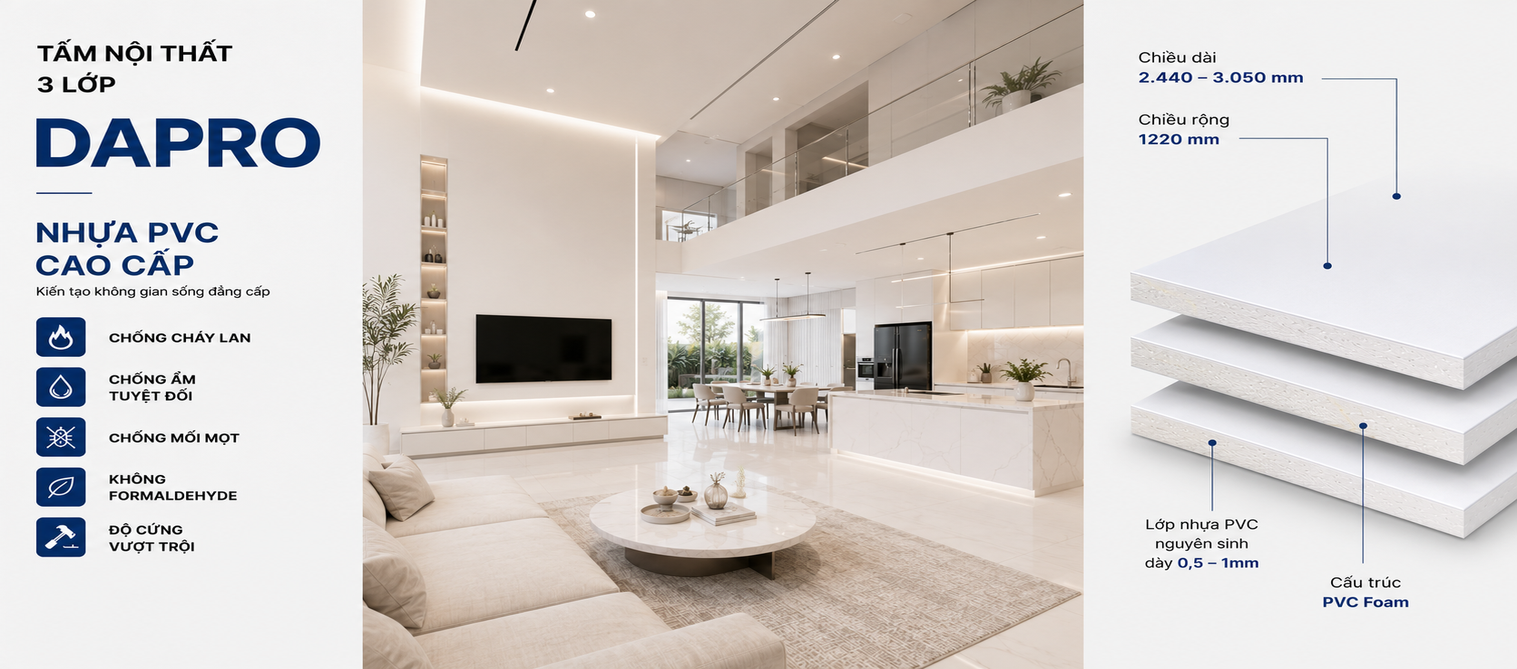
What is DAPro Co-extruded Foam Board?
DAPro Co-extruded Foam Board is a lightweight yet rigid material line, manufactured from virgin PVC (Polyvinyl Chloride) resin combined with foaming agents and specialized additives, meeting strict standards of quality and durability in the furniture industry.
DAPro Co-extruded Foam Board is a new generation interior material, developed for applications with higher demands on rigidity, warp resistance, and long term dimensional stability. While the celuka board is a flexible choice across the full spectrum of applications, the co-extruded board is the optimal choice for load bearing furniture and projects requiring the highest mechanical durability.
Structure of DAPro Co-extruded Foam Board
Central core layer A PVC foam structure, rigid yet lightweight, serving as the backbone of the board. The core design optimizes the stiffness to weight ratio: rigid enough to bear loads, light enough to avoid excessive stress on screw points and hinges.
Two outer surface layers Virgin PVC layers 0.5 to 1 mm thick each, finished flat and glossy with a higher density than the core, creating a surface hard enough for decorative coating, PVC film lamination, painting, or direct UV printing without further treatment.
Molecular level bonding The three layer structure is produced in a single closed loop extrusion process. Rather than three boards glued together, the three layers are formed simultaneously and bonded at the molecular level. DAPro completely eliminates the risk of delamination commonly seen in conventional plywood products.

Key Features of DAPro Co-extruded Foam Board

1. SUPERIOR RIGIDITY AND STABILITY

2. MOISTURE & MOLD RESISTANT

3. TERMITE RESISTANT

4. EASY TO PROCESS, LOW COST CONVERSION TO FINISHED PRODUCTS

5. FORMALDEHYDE FREE, SAFE TO USE

6. GLOSSY, HIGHLY AESTHETIC SURFACE

7. SUITABLE FOR CONSTRUCTION FORMWORK

8. FIRE SPREAD RESISTANT

9. EASY TO CLEAN SURFACE, NO MAINTENANCE COSTS

10. ADAPTED TO ALL CLIMATE CONDITIONS IN VIETNAM
Technical Specifications of DAPro Co-extruded Foam Board

Frequently Asked Questions About DAPro Co-extruded Foam Board
How does DAPro Celuka Foam Board differ from DAPro Co-extruded Foam Board?
- The co-extruded foam board offers higher rigidity and a glossier, more refined surface, and is typically used in premium projects, serving the high end segment at a higher price point. Meanwhile, the celuka foam board suits the mainstream segment at a reasonable price while still providing full moisture resistance, termite resistance, and formaldehyde free properties. In construction formwork applications, the co-extruded board is usually preferred over the celuka board because its smooth, flat surface is not corroded by concrete alkalization and does not shrink, chip, or warp during construction.
How does DAPro Co-extruded Foam Board differ from natural wood, MDF, and traditional materials?
- DAPro Co-extruded Foam Board has a density 40% to 50% lower than MDF, significantly reducing transportation and installation costs. Unlike natural wood and MDF, which are prone to mold, termites, and formaldehyde emissions from adhesives, DAPro Co-extruded Foam Board is absolutely moisture proof, completely termite resistant, and emits no formaldehyde. Its molecularly bonded three layer structure resists warping and maintains dimensional stability better than any engineered wood board in tropical climate conditions.
Can DAPro Co-extruded Foam Board be used for construction formwork?
- Absolutely, and this is one of the standout applications of the co-extruded board. Its smooth, flat surface is not corroded by concrete alkalization, and the board does not shrink or warp, allowing easy demolding and repeated reuse, saving significant costs compared with conventional wooden boards that can only be used once.
Can DAPro Co-extruded Foam Board be painted or covered with decals?
- Absolutely. The high density virgin PVC surface of the co-extruded board can be painted, laminated with PVC film, covered with decals, or UV printed directly without further treatment, meeting any custom color and imagery requirements in interiors and advertising.